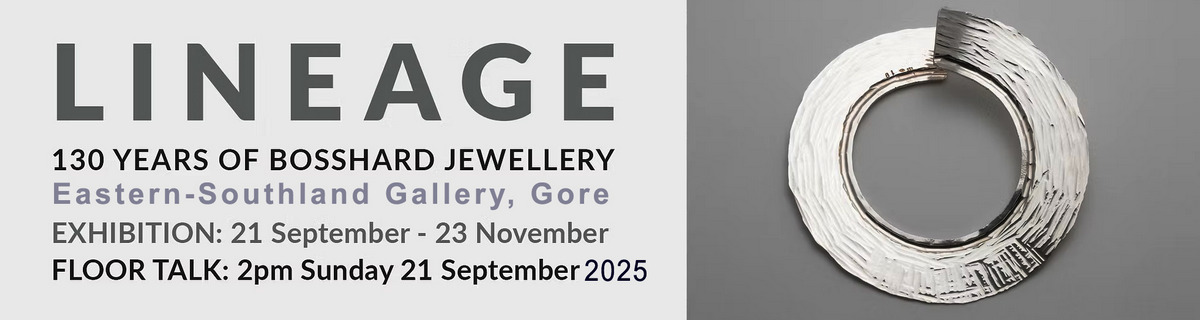
"My grandfather, Jakob Bosshard was born in 1870 in Uster, Switzerland, where his parents owned and operated a plant nursery. After completing his school years, he could not decide what he wanted to do, and because he suffered from a bad hip, there was no expectation for him to become a gardener and join the family business.
"It was however noted in school and at home, that he had a great talent for drawing, so he went for a year to the art school in Zürich, but still didn't really know what he wanted to do. An uncle who owned a jewellery manufacturing business in Zürich, challenged him; why don't you become a goldsmith? Jakob lukewarmly agreed. And so it was arranged that he would, in 1886 at the age of sixteen, serve an apprenticeship as an engraver in Pforzheim, then the centre of goldsmithing in Germany.
"Half his time was spent in the workshop learning engraving; the other half he attended the art school where he learnt drawing, design and art history. His drawings in this exhibition were done between the ages of sixteen and twenty. Completing his apprenticeship in 1889, he was now a journeyman, embarking on extending his skills and experience in other workshops in the region. For a year he worked for his uncle where he learnt to set gems. A couple years later, he worked in Budapest. And a testimonial from his employer there, is in our present exhibition. Now back in Zürich, he worked for his uncle for four years as an engraver and stone setter, and also learnt goldsmithing. In 1895, Jakob returned to Uster to start his own business, offering his services as goldsmith, engraver and designer of documents and certificates.
"In 1902, Jakob married Bertha Honneger, a piano teacher, who also came from an old Uster family, and in 1905, my father Heinrich was born. He had piano lessons from an early age, and was both talented and very keen. Bertha however died when Heiner was only twelve. Jakob was now the sole parent. Piano lessons continued with another teacher.
"When Heiner left school and it came to choosing a career, he decided to become a goldsmith like his father. I suspect that he received a bit more than encouragement from his father, who obviously wished his flourishing business to continue under the same name, as well as provide a living for his son.
"Heinrich was apprenticed to his uncle and completed his training in 1924. He continued studying music and playing piano, but at the same time, was becoming more interested in goldsmithing, and soon committed himself to the family business. Jakob was relieved and could now support the musician without fear.
"As journeyman, Heiner spent a year in Geneva, a few months in Berne, and a few months in Geisingen (Steig) to learn engraving. His last stop was Paris. He returned to Uster at the end of 1926, where he joined his father, and for the next ten years, the two of them shared their workbench, while he also carried on with his piano and music studies.
"I was born in 1939, named after my grandfather Jakob who had died three years earlier. With an older brother and sister, we lived above the family jewellery shop in the building my grandfather had built in 1930, which had other shops facing the main street of Uster and four flats above. At the back of the building, there was a lane where a number of tradespeople had their workshops. There was a hat maker, a butcher with a slaughterhouse, a joiner and cabinetmaker, a plumber and a shoemaker, and of course, my father's goldsmith workshop. The lane was our playground. We children had access to these workshops and learned how things were made, how animals were killed so we could eat meat.
"Our family life consisted of reading and music. Art was considered a fundamental element of life. We children never went to sleep without the sound of piano music. We were taken to concerts, to the theatre and art exhibitions.
"On weekends, we went for walking excursions into the hills. During the holidays, we went to the big mountains. My mother, Elisabet, had grown up in the Bernese Oberland, where her father - a keen mountaineer - had taken her up many mountains. She now took us on mountain trips, and we sometimes stayed in traditional alp huts where cows were pastured in summer and where alp cheese was made. From my mother, I inherited a love for the mountains, and as a youth, started serious mountaineering in the alps of Switzerland, France and Italy.
"My mother was also engaged politically and was outspoken, in contrast to my father who was rather a good 'status quo' citizen. In 1946, my younger sister Maja was born. She followed in our father's love for the piano, and later became a musician. In the early 1950s, my parents were keen for their shop to stock more house-made jewellery. They employed a goldsmith, Martin Bodmer, who designed and made a lot of work which then went into stock, and changed the character of the window displays. Herr Bodmer became my hero. I hung over his bench for hours. He suggested that an extra workbench be installed for me and one of the shopgirls who also showed interest. This was done, and the two of us made very simple pieces - mainly chains. After finishing school in 1956, my choice for a trade was very predictable; goldsmith.
"In order to provide a wider horizon, tradition prescribed that an apprentice of any trade did not learn from his own father. My father's heart, I felt, had never been fully engaged in goldsmithing. He retired on the day of his 65th birthday, the day he became a pensioner, and devoted all his time to music and the writing of a biography of his father. But he recognised that I was different. He approached Herr Burch-Korrodi who was the most prominent and innovative jeweller in Zürich, known internationally for his revolutionary design of religious chalices, crosses, monstrances and figurines - including one that was four metres in height for a cathedral in Germany.
"Herr Burch had a strict criteria for accepting an apprentice; only the son of a minister, or, a boy whose grandfather he knew. Herr Burch knew my grandfather, Jakob Bosshard.
"So it was a real honour to start my apprenticeship at Burch-Korrodi in 1956. Burch's workshop consisted of seven goldsmiths, two silversmiths, a stone setter, a polisher and a designer. The silversmiths made large pieces such as chalices, monstrances, and figurines for the Catholic church and for priests. The goldsmiths produced jewellery exclusively for the Burch-Korrodi shop in the main street of Zürich. The design of all the work was radically different from the work of other jewellers. Most ideas came from Herr Burch himself. The designer's job was to make these designs bench-ready.
"I sat beside the best goldsmith, Herr Gschwind, and he taught me the basic goldmithing skills. Then I practiced on simple production work, and over four years I advanced to be able to make Burch pieces.
"As apprentices, we spent four and a half days in our workshops, and one day at art school, where we learned and practiced drawing, modelling and design. We had theory about our materials, gems and techniques, part of the apprenticeship that lasted for four years.
"In order to qualify, the twelve jewellery apprentices from Zürich had to pass a final test. At the art school's workshop, we were given a design from which we had to make a piece of jewellery within a week. We were also tested on theoretical and technical questions. All twelve of us passed. A couple weeks later, at a meeting of the Goldsmiths Association of Zürich, we were handed our diplomas and welcomed into the goldsmith fraternity. We were now journeymen, ready to experience working-life in other workshops.
"In the 1950s, Scandinavia became very prominent in design. I wanted to go to Sweden. Then someone told me of a Swiss goldsmith in New Zealand. I wrote to him and he offered me a job. All that I knew about New Zealand, was, that it was very far away, and that it had very high mountains. So I accepted.
"In Amsterdam, I embarked on the ship, the Oranje, and saw the sea for the first time. After stops in Madeira, Florida, Panama, Tahiti, I arrived five weeks later in Auckland and then Wellington. I started work a few days after I had found accomodation.
"However it was not my job, but the other activities I became involved in, that were important to me. A passenger on our ship and her husband introduced me to the Hutt Valley Tramping Club. There I met a lot of good people. I went tramping with them in the Tararuas and the Orongorongas. I joined working parties at the club's hut in Ruapehu. Over winter, we went most weekends skiing from there. In Wellington, I got to know my fellow flatmates; German, Dutch and Scottish. I went to concerts and films, was introduced into families. I felt I was accepted positively and enjoyed living in Wellington.
"The job however, did not turn out very well. I left after six months, taking a labouring job at Central Park. I enjoyed that and had a very kind boss.
"Then, I went on a trip to the South Island. I loved it and didn't want to leave. I climbed a few mountains in Arthurs Pass and then went to Mount Cook where I met up with my Wellington climbing partners. We stayed there for over two months, climbing Mt. Cook, Mt. Tasman and other high peaks. I was prepared to do any work to enable me to stay. And a couple months later, a job at the Hermitage came up. Garbiologist. It was my responsibility to get rid of kitchen and other waste. I had to clean the public toilets in the hotel. I had to get firewood and light fires. It was not inspiring work, but I had my weekends and I was in good company.
"The Hermitage employed about sixty staff; most of them Australians on working holidays. Good blokes and nice girls. We all kept our jobs even in the off-season. The accomodation was excellent and there was a lot of fun. Soon after me, arrived a girl from Auckland. Her name was Patricia and she worked as a housemaid. We fell in love and a bit over a year later, we got married.
"Soon after, and as first-time parents, Patricia and I went to Switzerland before choosing where we ultimately wanted to settle. There, I worked for my father. We travelled a bit, then decided to come back to New Zealand. I got a job with a jeweller in Christchurch, and continued to also do my own work. We wanted now to settle down, and ideally get a house we could afford. We found a place in Akaroa; a beautiful old house with a large a garden and some out-buildings. It was within our price range. We moved there in 1967. I installed my first proper workshop and my jewellery career took off.
"In New Zealand at that time, there were very few of us who challenged the conservative conventional look of the available jewellery; there was Tanya Ashken in Wellington, Jens Hansen in Nelson, Gunther Taemmler and me in Canterbury. Many New Zealanders were now travelling overseas and becoming aware of modern design. When they discovered our work in the few galleries where we showed, they were excited and became our first loyal customers. At that time, there was a lot of pride in New Zealand-made. From then on, all of us could earn a living from our work.
"Around 1968, I was ready to take on an apprentice. The Akaroa school headmaster recommended a local farm boy. Peter McKay became my formal apprentice. He worked with me for five years and became a very good goldsmith.
"At that time, my work was still predominantly in the style of Burch-Korrodi. It took about ten years before my jewellery became my own. From then on, the work kept developing very slowly. I learned in practice, the inherent qualities of my materials and processes. I learnt to respect them, and to move away from contriving designs and imposing them on the metal. I learned to discover pieces of jewellery, rather than predict them. But parallel to this mode of working, I still made rings and pieces based on geometry and mapmaking, which had to be planned and drawn precisely.
"In 1976, we moved to Dunedin. I had various workshops by myself until, with Stephen Mulqueen, I started Fluxus as a jewellery workshop and outlet next to Patricia’s gallery in Dowling Street.
"Later, Fluxus expanded and moved to Lower Stuart Street, following the relocation there of Patricia’s gallery. Here, Lynn Kelly, Ann Culy, Georg Beer and I became the core members of a co-op, hosting many young jewellers for significant lengths of time in the workshop, where they worked alongside us, extending their work skills in the company of practitioners. Twenty years after its founding, Fluxus closed. I've continued to work from my present workshop near Middlemarch to this day.
"Working in New Zealand in relative isolation, I was able to grow up and develop my work in my own time and at my own pace. I was never influenced by trends and fashions and unrealistic ambitions. So now, I can confidently say that all the work I have made, is my own and is of New Zealand.
"I am grateful to my grandfather, my parents and my upbringing which enabled me to
follow-on in their trade and also forge my own path. I'm especially grateful to my wife Patricia who has been my toughest critic and best support over many years. And I'm grateful to those many people in both Switzefand and New Zealand who have sustained me through a career of sixty-five years."
Kobi Bosshard Talk: Eastern-Southland Gallery, 21/09/2025 |
